- Liquid Silicone Overmolding for Eye Masks: Redefining Comfort, Light Blocking and Skin Feel
- Application of Liquid Silicone in Dexterous Hands: A Material Revolution in Flexible Sensing and Precision Actuation
- Silicone Overmolding on Metal: Precision Encapsulation of Metal Inserts with LSR
- Silicone Overmolding on Nylon (PA): High-Strength PA-LSR Composite Injection Molding
- Silicone Overmolding on Plastic Substrate: Complete Guide to LSR-Plastic Bonding Technology
- Silicone Overmolding on Glass: Transparent Bonding and Precision Encapsulation Technology
Email:ping@yetiguijiao.com
Call Us:13678986139
Phone:13678986139
Address:No.10 Zifeng Street, Dalingshan Town, Dongguan City
Application of Liquid Silicone in Dexterous Hands: A Material Revolution in Flexible Sensing and Precision Actuation
With the rapid development of humanoid robots and bionic prosthetics, dexterous hands as core execution components demand exceptional flexibility, sensing precision, and durability. Liquid Silicone Rubber (LSR), with its outstanding elasticity, biocompatibility, temperature resistance, and processability, is driving a material revolution in dexterous hand manufacturing.
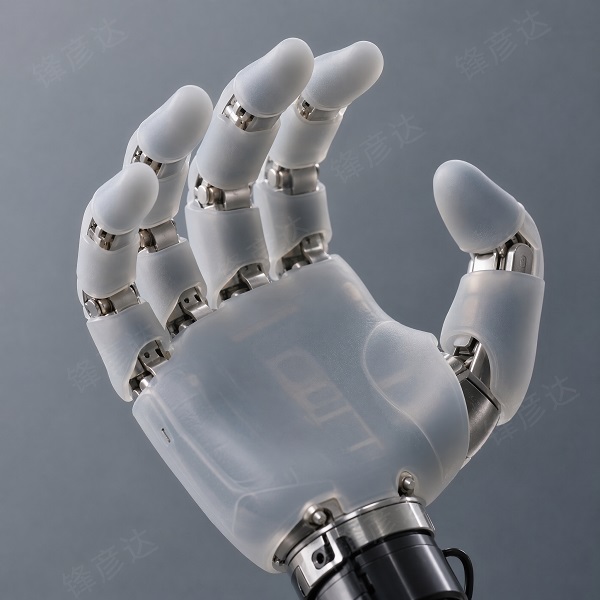
I. Core Applications of LSR in Dexterous Hands
1.1 Flexible Tactile Sensor Encapsulation
Dexterous hands require precise perception of contact force, temperature, texture, and slip. LSR as the encapsulation substrate for flexible tactile sensors offers unique advantages:
High Elasticity and Force Transmission: LSR's elastic modulus is adjustable (Shore A 10-50), efficiently transmitting external contact forces to internal sensing elements, achieving 0.01N-level force resolution.
Excellent Optical Transparency: Optical-grade LSR achieves over 90% light transmittance, enabling simultaneous measurement of contact position, pressure, and temperature when combined with FBG or photodiode arrays.
Environmental Durability: LSR maintains stable performance from -50°C to 200°C, resisting UV, ozone, and chemical cleaners, ensuring long-term reliability in industrial environments.
1.2 Bionic Skin and TactileCovering
Humanoid robots and advanced prosthetics require realistic appearance and touch. LSR is the preferred material due to its biocompatibility and adjustable tactile properties:
Tactile Realism: By adjusting LSR formulation (adding silica micropowder or silicone oil), the softness (Shore A 5-20) and friction coefficient of human skin can be precisely simulated.
Texture Replication: Precision injection molding can replicate microscopic textures such as fingerprints and pores on the LSR surface for highly realistic appearance.
1.3 Flexible Actuators and Artificial Muscles
The miniaturization and lightweight requirements of dexterous hands demand flexible actuation elements. LSR plays a key role in pneumatic artificial muscles and dielectric elastomer actuators (DEA):
Pneumatic Flexible Actuators: Hollow bellows structures integrally molded from LSR achieve finger bending and extension through pneumatic control. LSR's low elastic hysteresis ensures high repeat positioning accuracy.
Dielectric Elastomer Actuators: Conductive carbon grease or silver nanowire electrodes embedded in LSR薄膜 enable silent, frictionless compliant motion.
1.4 Sealing and Protection
Dexterous hands integrate精密 sensors, circuits, and driving elements requiring effective sealing: multi-material overmolding for waterproof sealing of sensor harnesses, and localized silicone sealing at joint gaps reaching IP68 protection level.
II. Key Technical Challenges and Solutions
2.1 Reliable Bonding of Dissimilar Material Interfaces
Dexterous hands typically consist of metal skeletons, plastic brackets, flexible circuits, and LSR coating layers. Using silane coupling agent primers (e.g., Dow Corning 1205OS) for metal and plasma activation with epoxy silane for plastic achieves bond strength above 8N/mm.
2.2 Precision Molding of Fine Structures
Sensor packaging requires LSR coating thickness of 0.1-0.5mm with microstructural precision of ±0.05mm. Micro-injection molding with precision molds (±0.005mm cavity accuracy) and micro-dosing systems (±0.01g injection accuracy), combined with vacuum-assisted injection, achieves micron-level LSR molding.
III. Application Prospects and Development Trends
As humanoid robot commercialization accelerates and smart prosthetic demand grows, LSR applications in dexterous hands will trend toward: integrated sensing-actuation, 4D printing technology with shape memory effects, neural interface fusion for mind-controlled prosthetics, and environmentally sustainable bio-based LSR materials.
Keywords: Liquid Silicone Dexterous Hand
- Previous:Silicone Overmolding on Nylon (PA): High-Strength PA-LSR Composite Injection Molding
- Next:N/A
- Liquid Silicone Overmolding for Eye Masks: Redefining Comfort, Light Blocking an
- Application of Liquid Silicone in Dexterous Hands: A Material Revolution in Flex
- Silicone Overmolding on Metal: Precision Encapsulation of Metal Inserts with LSR
- Silicone Overmolding on Nylon (PA): High-Strength PA-LSR Composite Injection Mol
- Silicone Overmolding on Plastic Substrate: Complete Guide to LSR-Plastic Bonding
- Silicone Overmolding on Glass: Transparent Bonding and Precision Encapsulation T
- Liquid Silicone Overmolding on PC: A Comprehensive Guide from Material Principle
- Liquid silicone encapsulation applications in consumer electronics: double break
- Application of medical grade liquid silicone encapsulation in implantable device
- Application of liquid silicone coated plastic in consumer electronics: An in-dep